• 01.06.

    Keynote

    - | Sitzungssaal | German

    Keynote: The Durkheim Test: How Close Are Artificial Intelligence Algorithms to Us?
    Foto von User

    Prof. Dr. Dirk Baecker

    Vita

    Professor Dirk Baecker served as a senior professor of organizational and social theory at Zeppelin University in Friedrichshafen on Lake Constance until 2025. After studying sociology and economics in Cologne and Paris, he earned his doctorate and habilitation at Bielefeld University. Since 1996, he has taught sociology at Witten/Herdecke University and Zeppelin University. His research focuses on sociological theory, cultural theory, and the “next society” of electronic media. Publications on this topic include: Studies on the Next Society (Suhrkamp, 2007), 4.0 or the Gap Left by the Computer (Merve, 2018), and Digitalization (Suhrkamp, 2026). Website: dirkbaecker.de.

    In his keynote address at Data Week, Professor Dirk Baecker offers a fundamental perspective on the relationship between humans and machines in the age of digitalization. The focus is not on the oft-discussed question of whether technology will replace hard labor or human fallibility, but rather on the growing ability of digital systems to integrate cooperatively and communicatively into human interactions. Digital technologies and artificial intelligence act as a mirror of our society—and at the same time reveal how difficult it is for us to recognize ourselves in them. How do we communicate meaningfully with machines? How much closeness is productive, and how much distance is necessary? And how much interconnection between humans and digital systems can a digital city tolerate? The keynote explores these questions and highlights which patterns of human interaction—particularly in urban spaces—are becoming visible through digitalization. It invites us to rethink what form of digitalization our society needs.

  • 01.06.

    Keynote

    - | Sitzungssaal | German

    Keynote: make bureaucracy great again - What lies at the end of the rainbow of AI-driven government modernization? (Live translation available in English.)
    Foto von User

    Gerald Swarat Fraunhofer-Institut für Experimentelles Software Engineering IESE

    Vita

    Gerald Swarat holds degrees in history and German studies and serves as the full-time director of the Berlin liaison office of Fraunhofer IESE (Kaiserslautern), which advocates for a better quality of life, sustainability, and economic success through reliable and resilient software and systems engineering. His main areas of focus are the impacts of digital transformation on government and society, and in particular digital change at the local level—in major cities, but especially in rural areas.He serves as Digital Advisor to the State of Saxony-Anhalt, Digitalization Ambassador for Mecklenburg-Western Pomerania, author of the book “Smart Land—From Smart City to Digital Region,” and co-founder of Co:Lab, a think tank and collaboration platform for society and digitalization.

    Anyone who, when discussing AI today, talks only of innovation, progress, productivity, and a “lean government” is overlooking the core issues surrounding power, inequality, and the erosion of the rule of law. Are we facing a state that replaces accountability with probability and arguments with algorithms? Have we truly understood enough about the power and profit interests of those whose technologies we intend to use as the supposed solution to our problems?

  • 02.06.

    Keynote

    - | Sitzungssaal | English

    Keynote: When AI takes your place
    Foto von User

    Dr. Martin Brynskov University of Copenhagen

    Vita

    Martin Brynskov, PhD (CS), is an academic and digital standardisation expert at the University of Copenhagen, where he serves as scientific director of AI and Digital. He is currently writing a book titled When AI Takes Your Place, exploring how artificial intelligence reshapes institutions, infrastructure and everyday life as it unfolds in communities of different sizes. His research examines how people, machines and hybrid systems perceive, conceptualise and act together in shared environments, framed as Interaction Technologies within a Place-Based Computing paradigm.

    Brynskov has led some of the world’s largest pilot studies on smart and sustainable cities and communities, focusing on connecting communities, data spaces, local digital twins, artificial intelligence and the internet of things. He is Standardisation Lead and former Founding Chair at the Brussels-based global NGO Open & Agile Smart Cities & Communities (OASC), co-chairs the Danish Standards committee on data management and data spaces, and represents Denmark in European and international standardisation work on data spaces, local digital twins and smart sustainable cities and communities.

    Based in Copenhagen, Denmark, Dr Brynskov works globally as a researcher, innovator, educator and facilitator, bridging research, policy, standards and large-scale experimentation.

  • 03.06.

    Keynote

    - | Sitzungssaal | English

    eccenca Corporate Memory Marketplace: Plug, Play, Deliver
    Foto von User

    Dr.-Ing. Nour Ramzy eccenca GmbH

    Vita

    Nour Ramzy is a Senior Knowledge Engineer at eccenca GmbH with several years of experience in the semiconductor domain, applying semantic technologies to model, integrate, and harmonize complex industrial data. During her PhD, she designed and implemented a synthetic semantic data generator for supply chain and manufacturing data, enabling the creation of realistic, interoperable datasets for testing and validation solution development. She also gained exposure to various manufacturing standards and industry consortia, further strengthening her expertise in semantic interoperability and data integration. Currently, she works as a consultant and Linked Data Expert collaborating with diverse customers across multiple domains to translate complex business challenges into scalable, production-ready solutions by leveraging semantic technologies and knowledge-driven approaches.

    This keynote introduces the application marketplace for eccenca Corporate Memory, a new approach to delivering knowledge- and data-driven solutions faster and more efficiently. The marketplace serves as a cross-organizational hub for reusable solutions, bringing together key building blocks such as ontologies, vocabularies, taxonomies, Python plugins, and integration projects. By making existing assets easy to find and apply, organizations can quickly match needs with available solutions, identify gaps or misalignments early, hence reducing communication overhead and ensuring compatibility across projects. It also accelerates implementation by providing ready-to-use components that can be easily adapted to specific contexts. Teams can draw inspiration from proven solution blueprints, enabling them to build on existing best practices rather than starting from scratch.

    Join this session to learn how to accelerate value delivery in your organization by streamlining the lifecycle from development to deployment in a scalable and standardized way.

  • 03.06.

    Keynote

    - | Sitzungssaal | English

    eccenca Corporate Memory Marketplace: Plug, Play, Deliver
    Foto von User

    Marcel Fröhlich eccenca GmbH

    Vita

    Marcel is the director of service delivery at eccenca. He holds a degree in computer science (Uni Tübingen & VU Amsterdam) and an MBA from ESB Reutlingen. Marcel jumped early into the Berlin ecosystem in 2000 founding relevantive, a user experience startup. Afterwards he spent 10 years in the corporate world serving in various management positions in T‑Systems International GmbH. He was responsible for substantial project & consulting business in various industries mostly focused on business information management.

    This keynote introduces the application marketplace for eccenca Corporate Memory, a new approach to delivering knowledge- and data-driven solutions faster and more efficiently. The marketplace serves as a cross-organizational hub for reusable solutions, bringing together key building blocks such as ontologies, vocabularies, taxonomies, Python plugins, and integration projects. By making existing assets easy to find and apply, organizations can quickly match needs with available solutions, identify gaps or misalignments early, hence reducing communication overhead and ensuring compatibility across projects. It also accelerates implementation by providing ready-to-use components that can be easily adapted to specific contexts. Teams can draw inspiration from proven solution blueprints, enabling them to build on existing best practices rather than starting from scratch.

    Join this session to learn how to accelerate value delivery in your organization by streamlining the lifecycle from development to deployment in a scalable and standardized way.

About the Data Week Leipzig

Data Week Leipzig is a networking event that highlights the scientific, economic and social perspectives of data and its use. Representatives from authorities, industry, science and business will enter into a dialog.

We welcome the participants to Leipzig to get exciting insights in a week of events with numerous sessions. The latest trends and developments relating to the digital city and the use of artificial intelligence will be presented. There will be a special focus on climate and energy. There will also be the opportunity to take part in training sessions and workshops. One day will be dedicated to semantics and AI, and speakers will provide insights into how these technologies can contribute to a sustainable and resilient future.

Show more

The organizers would also like to invite students, trainees and interested citizens to take a look behind the scenes or take part in the various training courses offered during Data Week Leipzig. You can look forward to a week of events with an inspiring program that also includes practical use cases.
Impressions of Data Week Leipzig 2025

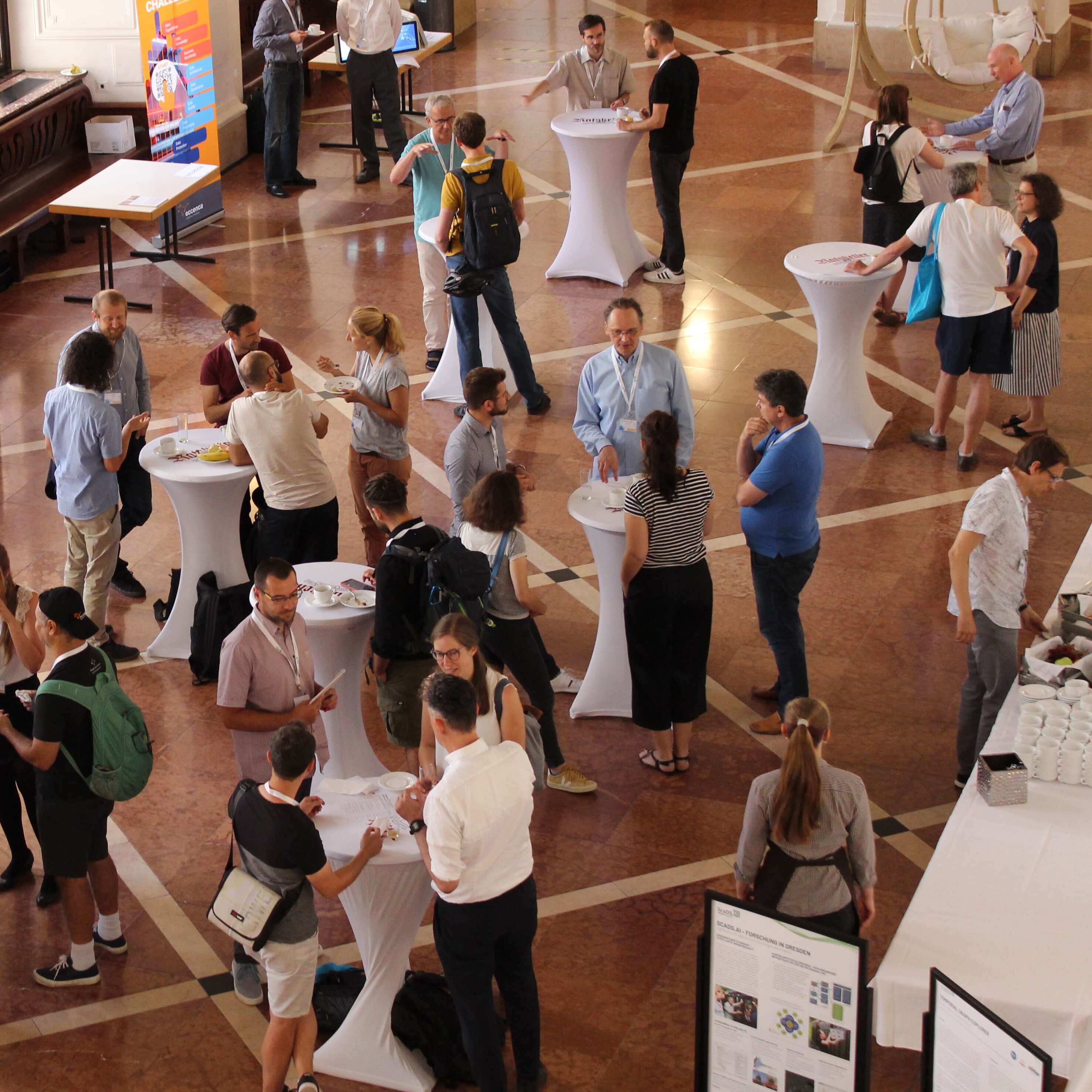
An exciting week of events (June 10-13, 2025) for start-ups, students and representatives from business, science and administration lies behind us. Over 550 participants networked at the New Leipzig City Hall and exchanged ideas on topics such as AI, digitalization and data. Among the more than 90 program items were 27 workshops, 5 training sessions and 75 lectures - supplemented by exciting keynotes, including from Prof. Dr. Miguel D. Mahecha on environmental research and Renate Mitterhuber on the smart city. New formats such as the two-day Thin[gk]athon, the Civic Coding and AIAMO roadshows, the “Gamechanger Data” innovation forum, the start-up consulting service and the “Art of Data” visualization were also a hit. The KMI Transfer Day and the Leipzig Semantic Web Day also took place again in 2025.

  • Image of the dataweek opening in front of the audience at Sitzungssaal
  • Presenter during a talk at Festsaal.
  • Image of a talk of AIAMO project in front of the audience at Ratsplenarsaal.

Data Week Hosts

Data Week In cooperation with

Data Week Sponsors